Skip to product information
1 of 1

Omni Peptides

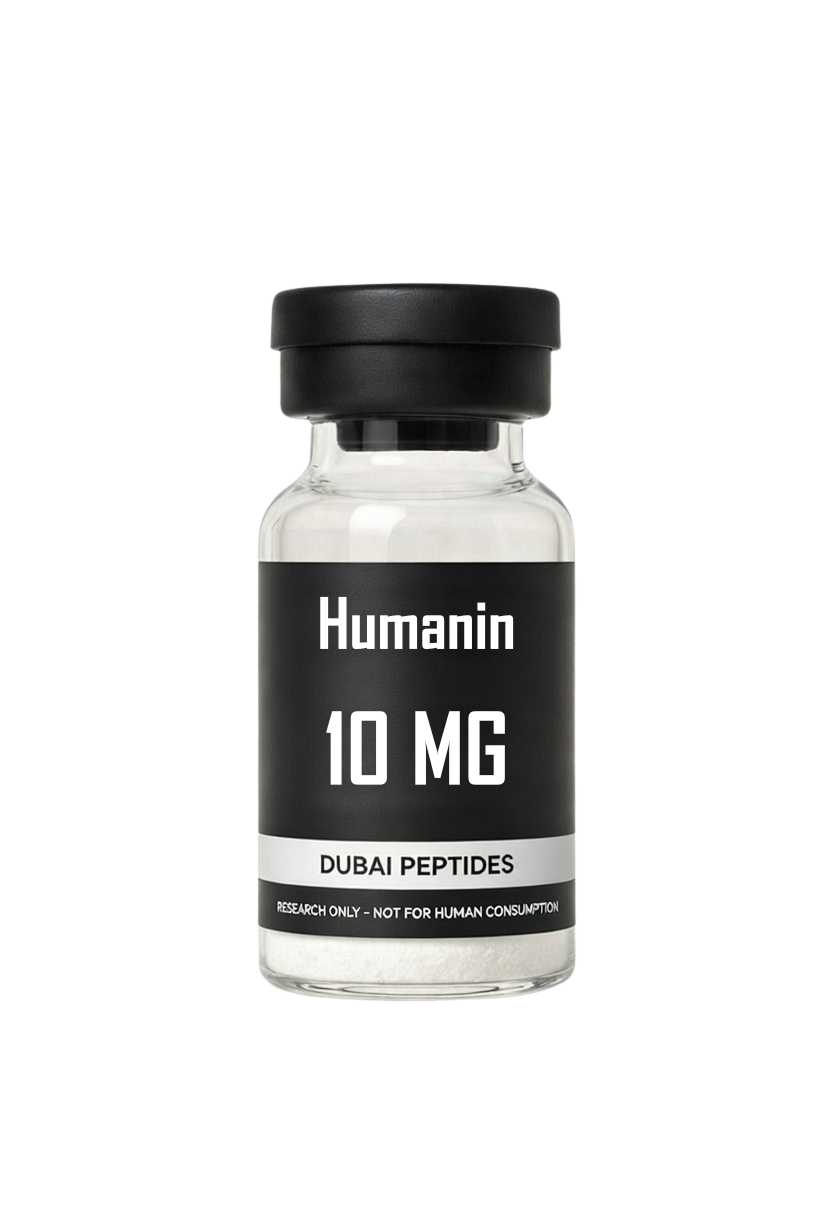
Humanin

Regular price Dhs. 850.00 AED
Regular price Sale price Dhs. 850.00 AED
Sale Sold out
CHOOSE YOUR FORMAT

Size
Quantity
Lyophilised & sealed vials
Independent COA · ≥99% purity
Cold-chain dispatch · same day Dubai
Discreet · unbranded outer packaging

Humanin is a synthetic mitochondrial-derived peptide (MDP) consisting of 24 amino acids, encoded by a short open reading frame within the 16S ribosomal RNA gene (MT-RNR2) of the mitochondrial genome. This research compound has attracted substantial scientific interest as one of the most potent and well-characterized cytoprotective and neuroprotective peptides identified to date. Preliminary and advanced preclinical studies demonstrate that humanin exerts broad protective effects against cellular stress, apoptosis, oxidative damage, and inflammation through multiple mechanisms, including interaction with extracellular receptors (e.g., FPRL1/formyl peptide receptor-like 1), intracellular binding partners (e.g., Bax, Bid, IGFBP-3), and modulation of STAT3, ERK, and AKT signaling pathways. Researchers utilize humanin (and its more potent analogs such as HNG or HN-F6A) in laboratory and animal models to investigate mechanisms of mitochondrial-mediated cytoprotection, neurodegeneration, metabolic disorders, cardiovascular disease, and aging-related pathologies. As a research-grade compound, humanin is intended exclusively for in vitro and animal studies. Scientists value its remarkable potency at nanomolar to picomolar concentrations, its ability to cross the blood-brain barrier, and its potential as a prototype for developing mitochondrially-targeted therapeutics.

Molecular Formula
C₁₁₉H₂₀₄N₃₄O₃₂S₂
Molecular Weight
2656.3 g/mol (native humanin)
Sequence
Met-Ala-Pro-Arg-Gly-Phe-Ser-Cys-Leu-Leu-Leu-Leu-Thr-Ser-Glu-Ile-Asp-Leu-Pro-Val-Lys-Arg-Arg-Ala
01 Neuroprotection and Neurodegenerative Disease Models
Humanin potently protects neurons from amyloid-β toxicity, oxidative stress, and serum deprivation in Alzheimer’s disease models. It reduces tau hyperphosphorylation, inhibits Aβ-induced apoptosis, and improves cognitive function in transgenic AD mouse models. Studies also show benefits in Parkinson’s, ALS, and stroke models by preserving mitochondrial integrity and reducing neuronal loss.
02 Mitochondrial Function and Cytoprotection
Humanin stabilizes mitochondrial membrane potential, prevents Bax/Bak oligomerization, blocks cytochrome c release, and inhibits the mitochondrial permeability transition pore. It protects against ischemia-reperfusion injury in heart, brain, and retina, and ameliorates mitochondrial dysfunction in various stress paradigms.
03 Metabolic Health and Diabetes
Investigations reveal that humanin improves insulin sensitivity, enhances glucose uptake, reduces hepatic glucose production, and protects pancreatic β-cells from cytokine-induced apoptosis in models of type 1 and type 2 diabetes. It also mitigates diabetic retinopathy and nephropathy in preclinical models.
04 Cardiovascular Protection
Humanin reduces myocardial infarct size, improves post-ischemic cardiac function, and protects endothelial cells from oxidative damage and atherosclerosis progression. Research highlights its anti-apoptotic and anti-inflammatory effects in cardiomyocytes and vascular tissues.
05 Aging, Longevity, and Systemic Protection
Circulating humanin levels decline with age in humans and rodents. Supplementation in aged animals extends healthspan markers, reduces inflammation, improves metabolic parameters, and protects against age-related pathologies including sarcopenia, macular degeneration, and hearing loss.
Storage & Handling

Lyophilised vials are stable at −20°C for up to 2 years unopened. Once reconstituted, refrigerate at 2–8°C and use within 28 days. Avoid repeated freeze-thaw cycles.

Beyond Use Date

Pre-filled formats (cartridge, pen, nasal) carry a beyond-use date of typically 4–8 weeks from receipt. ≥98% purity by HPLC. For in vitro and preclinical research use only — not for human or veterinary use.

Molecular Formula
C₁₁₉H₂₀₄N₃₄O₃₂S₂
Molecular Weight
2656.3 g/mol (native humanin)
Sequence
Met-Ala-Pro-Arg-Gly-Phe-Ser-Cys-Leu-Leu-Leu-Leu-Thr-Ser-Glu-Ile-Asp-Leu-Pro-Val-Lys-Arg-Arg-Ala

— About this compound

Humanin is a synthetic mitochondria-derived cytoprotective peptide.

Humanin is a synthetic mitochondrial-derived peptide (MDP) consisting of 24 amino acids, encoded by a short open reading frame within the 16S ribosomal RNA gene (MT-RNR2) of the mitochondrial genome. This research compound has attracted substantial scientific interest as one of the most potent and well-characterized cytoprotective and neuroprotective peptides identified to date. Preliminary and advanced preclinical studies demonstrate that humanin exerts broad protective effects against cellular stress, apoptosis, oxidative damage, and inflammation through multiple mechanisms, including interaction with extracellular receptors (e.g., FPRL1/formyl peptide receptor-like 1), intracellular binding partners (e.g., Bax, Bid, IGFBP-3), and modulation of STAT3, ERK, and AKT signaling pathways. Researchers utilize humanin (and its more potent analogs such as HNG or HN-F6A) in laboratory and animal models to investigate mechanisms of mitochondrial-mediated cytoprotection, neurodegeneration, metabolic disorders, cardiovascular disease, and aging-related pathologies. As a research-grade compound, humanin is intended exclusively for in vitro and animal studies. Scientists value its remarkable potency at nanomolar to picomolar concentrations, its ability to cross the blood-brain barrier, and its potential as a prototype for developing mitochondrially-targeted therapeutics.

VIAL ANATOMY
LYOPHILISED VIAL
Flip-off cap
Tamper-evident seal
Rubber stopper
Bacteriostatic-water compatible
Batch-labelled body
Lot & expiry printed
USP Type I glass
Borosilicate, sealed
Humanin vial
Humanin
10 MG
DUBAI PEPTIDES
RESEARCH USE ONLY
BLACK RESEARCH SERIES

Research Applications

Where researchers apply it.

01 Neuroprotection and Neurodegenerative Disease Models
Humanin potently protects neurons from amyloid-β toxicity, oxidative stress, and serum deprivation in Alzheimer’s disease models. It reduces tau hyperphosphorylation, inhibits Aβ-induced apoptosis, and improves cognitive function in transgenic AD mouse models. Studies also show benefits in Parkinson’s, ALS, and stroke models by preserving mitochondrial integrity and reducing neuronal loss.
02 Mitochondrial Function and Cytoprotection
Humanin stabilizes mitochondrial membrane potential, prevents Bax/Bak oligomerization, blocks cytochrome c release, and inhibits the mitochondrial permeability transition pore. It protects against ischemia-reperfusion injury in heart, brain, and retina, and ameliorates mitochondrial dysfunction in various stress paradigms.
03 Metabolic Health and Diabetes
Investigations reveal that humanin improves insulin sensitivity, enhances glucose uptake, reduces hepatic glucose production, and protects pancreatic β-cells from cytokine-induced apoptosis in models of type 1 and type 2 diabetes. It also mitigates diabetic retinopathy and nephropathy in preclinical models.
04 Cardiovascular Protection
Humanin reduces myocardial infarct size, improves post-ischemic cardiac function, and protects endothelial cells from oxidative damage and atherosclerosis progression. Research highlights its anti-apoptotic and anti-inflammatory effects in cardiomyocytes and vascular tissues.
05 Aging, Longevity, and Systemic Protection
Circulating humanin levels decline with age in humans and rodents. Supplementation in aged animals extends healthspan markers, reduces inflammation, improves metabolic parameters, and protects against age-related pathologies including sarcopenia, macular degeneration, and hearing loss.

— Verified & Documented

Every vial is backed by a Certificate of Analysis.

Each lot is independently characterised by HPLC and mass spectrometry, with identity, mass and purity documented per batch and available on request.

Additional quality-control testing, including sterility, endotoxin and heavy metals, is conducted periodically across our product range.

>99%
HPLC Purity
MS
Identity Confirmed
Certificate of Analysis
HUMANIN · QC RELEASE
PASS
IdentityConfirmed
Mass—
Purity>99%
AppearanceWhite Lyophilised
LabJanoshik Analytical (Independant)
Date

Storage & Handling

Storage & Handling

Lyophilised vials are stable at −20°C for up to 2 years unopened. Once reconstituted, refrigerate at 2–8°C and use within 28 days. Avoid repeated freeze-thaw cycles.

Beyond Use Date

Pre-filled formats (cartridge, pen, nasal) carry a beyond-use date of typically 4–8 weeks from receipt. ≥98% purity by HPLC. For in vitro and preclinical research use only — not for human or veterinary use.